
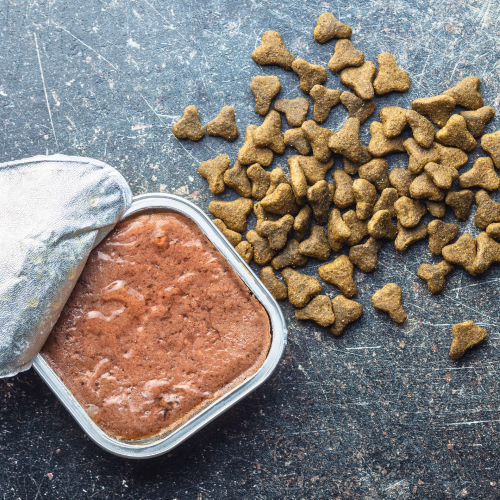
Thinking about mixing wet and dry dog food? Discover five benefits of mixed feeding for dogs, from making meals more appealing to balancing your budget. Plus, learn how to calculate portions, avoid overfeeding and choose a combination that suits your dog’s nutritional needs.
Feeding your dog can feel unnecessarily complicated. One person insists on kibble, another swears by wet food, and social media has somehow convinced you that dinner needs seventeen ingredients, chopping skills of a head chef and a decorative blueberry.
Here’s a little secret, you don’t have to choose just one food format.
Combo feeding for dogs, also called mixed feeding, usually means feeding a combination of wet and dry dog food. When the foods are suitable and portions are calculated correctly, it can be a practical way to feed your dog.
As a canine nutritionist, I’m interested in whether a diet meets your dog’s needs, suits their digestion and works for your household. Combining foods can help with that, but it isn’t automatically healthier than feeding one complete food.
Here are five benefits worth considering.
What is combo feeding for dogs?
For this article, combo feeding means combining complete wet and dry dog foods. You might mix them in the same bowl or serve them at separate meals.
There is no compulsory ratio. Some dogs have mostly dry food with a measured amount of wet, while others have a more even split of their daily calories.
The key is to choose foods appropriate for your dog’s life stage and health, then work out how much of each to feed. UK Pet Food recognises mixed feeding as an option, with nutritional suitability taking priority over format.
If you’re weighing up the differences, read my guide to dry food vs wet food for dogs.
1. It can make meals more appealing
Some dogs enjoy the aroma and softer texture of wet food alongside their usual kibble. A measured portion may make meals more appealing without needing a growing collection of cheese, ham and whatever else is in the fridge.
Using a complete wet food also means that the wet portion contributes balanced nutrition, rather than simply adding extras.
However, a dog who suddenly becomes reluctant to eat needs more than a tastier dinner. Dental pain, nausea and other health problems can affect appetite.
And if every refused meal receives an immediate upgrade, mealtimes can become increasingly difficult to manage.
For more on this, read my guide to fussy dogs, appetite changes and better mealtimes.
2. It adds moisture to your dog’s food
Wet food typically contains around 70–80% moisture, so including it increases the water provided through meals.
That can be useful for owners who want to include more moisture in their dog’s diet while retaining the convenience of dry food.
It doesn’t mean that dogs eating kibble are automatically dehydrated. Healthy dogs can meet their water needs through drinking, and fresh drinking water should always be available, whatever you feed.
If your dog has a condition affecting hydration or needs a particular urinary diet, discuss the food combination with your vet. Adding any wet food is not equivalent to feeding a diet formulated for that condition.
3. It can help balance your feeding budget
Feeding only wet food can become expensive, particularly with larger dogs or several dogs in the household. Dry food is often cheaper per calorie.
Combo feeding lets you include some wet food while using dry food to supply the remaining calories. The saving depends on the products and proportions you choose, but it gives you more flexibility.
Compare cost per day, rather than just the price of a bag or tray. Foods contain different amounts of water and energy, so price per kilogram can be misleading.
There is also no nutritional prize for stretching your budget beyond what you can comfortably afford. A suitable complete diet should work for your dog and your household.
My blog on mistakes owners make when choosing dog food explains more about looking beyond marketing claims.
4. It gives you more options for training and enrichment
Mixed feeding can make your dog’s daily food allowance useful in different ways.
You could reserve some dry food for training rewards or a suitable puzzle feeder, then use part of the wet portion in a food toy or on a lick mat.
This gives you options for how meals are offered without automatically adding more treats.
The important detail is that it all comes from the calculated daily allowance. Food used during a walk, in an enrichment toy or while practising recall still counts.
Use toys suited to your dog, supervise where appropriate and clean equipment thoroughly after use.
5. It can offer a larger portion for the same calories
Because wet food contains more water, it is generally less calorie dense by weight than dry food.
Replacing some kibble calories with an appropriate wet food can therefore create a larger food portion without increasing the total calories.
For some dogs, that may be useful when managing portions. However, a bigger-looking dinner does not guarantee better fullness or weight loss. Protein, fibre, the overall formulation and your dog’s individual response all matter.
Simply adding wet food to an unchanged dry portion increases calories, which can lead to weight gain.
If your dog’s waistline is changing, read reasons your dog may have gained weight.
How to mix wet and dry dog food correctly
For healthy adult dogs, my usual starting point is up to 80% of daily food calories from a suitable complete dry food and up to 20% from a suitable complete wet food.
This keeps dry food as the main foundation, while including wet food for its aroma, texture and moisture. It also makes portions and costs straightforward to manage.
This is my practical starting point, rather than a universal nutritional limit. Combining two suitable complete foods does not inherently unbalance a diet, and other ratios may also work well.
The percentages refer to calories, not the weight of food. Wet food contains considerably more water, so 20% of the calories may look like a surprisingly generous portion.
What does an 80:20 split look like?
Imagine your dog has a daily food allowance of 600 kcal, after accounting for treats:
80% of calories from dry food = 480 kcal. If the dry food contains 400 kcal per 100g, that means feeding 120g.
20% of calories from wet food = 120 kcal. If the wet food contains 100 kcal per 100g, that means feeding 120g.
Together, these provide 600 kcal per day, divided between your dog’s meals.
These figures are an example, not a feeding recommendation for every dog. Your dog’s calorie needs and the energy content of the foods determine the actual amounts.
Does this apply to complementary wet food?
No. This approach assumes both foods are complete and appropriate for your dog’s life stage and health.
Complementary wet foods, plain meat and other unbalanced toppers should generally stay within 10% of daily calories, including other treats, unless the overall diet has been professionally balanced.
If your dog follows a veterinary diet or an elimination trial, check with your vet or nutritionist before combining foods.
Does the wet food need to be complete?
If wet food supplies a substantial share of the diet, choose a product labelled complete and appropriate for your dog.
A complementary food, plain meat or a homemade topper does not automatically provide balanced nutrition. Treats and unbalanced extras should generally stay within 10% of daily calories unless the overall diet has been professionally formulated.
Is combo feeding suitable for every dog?
Some dogs need a more controlled approach.
If your dog has pancreatitis, kidney disease, urinary stones or another condition managed through diet, check that both foods fit the treatment plan. Even wet and dry products from the same brand may differ in important ways.
During an elimination diet, adding an ordinary wet food can also undermine the trial. My guide to elimination diets for dogs explains why consistency matters. If you are doing an elimination diet with a hydrolysed dry food and want to add a wet do so with the same product range.
Need help getting the balance right?
Combo feeding can offer appealing meals, extra dietary moisture and practical flexibility. It works best when both foods suit your dog and their portions have been worked out properly.
If you’re unsure which foods to combine or how much to feed, book a nutrition consultation with The Canine Dietitian for an individual assessment.
Further reading
This article provides general information and does not replace individual veterinary advice, diagnosis or a tailored nutrition plan.
